Resume vs. CV: Key Differences Every Job Seeker Must Know in 2026
Published on February 8, 2026 • 6 min read
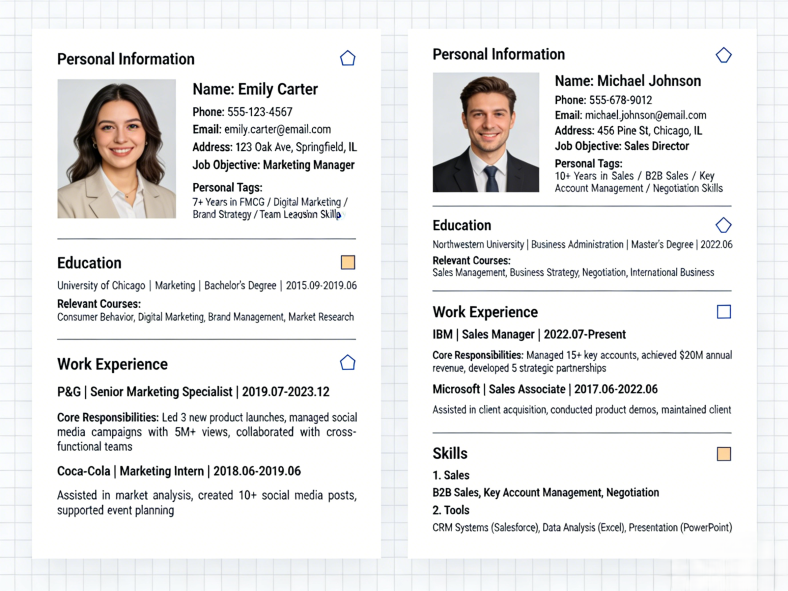
Did you know that choosing the wrong document format can get your application rejected by AI scanners instantly? In today's competitive job market, understanding the difference between a Resume and a CV isn't just about semantics—it's about getting past Applicant Tracking Systems (ATS) and landing interviews.
Many job seekers use these terms interchangeably, but they serve different purposes and are required for different types of positions. Submitting a CV when the employer expects a resume (or vice versa) can signal that you don't understand the role or the industry norms.
What is a Resume?
A resume is a concise, targeted document that highlights your skills, experiences, and achievements relevant to a specific job opening. It's designed to be quickly scanned by both human recruiters and ATS software.
Key characteristics of a resume:
- Length: Typically 1-2 pages (1 page for entry-level, 2 pages for experienced professionals)
- Focus: Skills and achievements directly relevant to the job
- Format: Reverse-chronological or functional format
- Content: Work experience, skills, education, certifications
- Customization: Tailored to each specific job application
Resumes are the standard for most corporate jobs, tech positions, sales roles, and general business applications. They're designed to showcase your most relevant qualifications in a format that ATS can easily parse and rank.
What is a CV?
A CV (Curriculum Vitae) is a comprehensive document that provides an in-depth overview of your entire academic and professional history. The term is Latin for "course of life," and that's exactly what it represents—a complete record of your career journey.
Key characteristics of a CV:
- Length: Can be 2+ pages, often extending to 5-10 pages or more for senior academics
- Focus: Academic achievements, research, publications, teaching experience
- Format: Chronological with detailed sections for each area
- Content: Education, research, publications, presentations, grants, awards, teaching
- Customization: Less customized, more of a comprehensive record
CVs are primarily used in academic, research, medical, and scientific fields. They're essential for PhD programs, professorships, research positions, and medical residencies. In Europe and many other countries, "CV" is often used to refer to what Americans call a resume.
The ATS Perspective: Does the Robot Care?
Here's the surprising truth: ATS software doesn't care whether you call it a resume or a CV. What matters is how well your document is formatted and optimized for keyword matching.
Modern ATS systems scan your document for:
- Keywords: Skills, qualifications, and job-specific terms
- Formatting: Clean structure, standard headings, no complex layouts
- Relevance: How well your experience matches the job requirements
- Completeness: Contact information, work history, education details
Whether you submit a 1-page resume or a 5-page CV, the ATS will extract the same data points: your name, contact info, work experience, skills, and education. The difference lies in how human recruiters perceive your document and whether it meets their expectations for the role.
Pro tip: If you're applying to a corporate job with a CV, the recruiter might think you're not familiar with industry norms. Conversely, submitting a 1-page resume for a professorship position will likely result in immediate rejection.
How to Choose?
The decision between resume and CV depends on your target industry, location, and the specific requirements of the job posting. Here's a quick reference guide to help you decide:
| Factor | Use a Resume | Use a CV |
|---|---|---|
| Industry | Corporate, tech, business, sales, marketing, finance | Academic, research, medical, scientific, education |
| Job Type | Most professional positions, internships, entry-level jobs | Professorships, research positions, PhD programs, medical residencies |
| Location | United States, Canada (most jobs) | Europe, UK, Australia (often called CV but means resume), US academic positions |
| Length | 1-2 pages maximum | 2+ pages, no strict limit |
| Focus | Skills and achievements relevant to the job | Complete academic and professional history |
| Customization | Highly customized for each application | Less customized, more comprehensive |
Quick decision flow:
- Check the job posting: Does it specify "resume" or "CV"? Follow their preference.
- Consider the industry: Corporate/tech = resume; Academic/research = CV.
- Think about location: US/Canada = resume (usually); Europe/UK = CV (often means resume).
- Evaluate your experience: Extensive research/publications? Consider a CV.
💡 Pro Tip: ATS-Ready Templates
No matter which one you need, using a professional AI-optimized template is a must. Our templates are designed to pass ATS scanners while looking polished and professional.
Final Thoughts
Understanding the difference between a resume and a CV is crucial for job search success in 2026. While ATS systems focus on content and keywords rather than document type, human recruiters still have strong expectations based on industry norms.
Remember:
- Always check the job posting for specific requirements
- Match your document type to the industry and location
- Optimize for ATS regardless of whether it's a resume or CV
- Keep resumes concise (1-2 pages) and CVs comprehensive
- Use professional templates designed for ATS compatibility
By choosing the right format and optimizing for ATS, you'll significantly increase your chances of landing interviews and securing your dream job. Ready to optimize your resume or CV? Try our free resume score checker today!